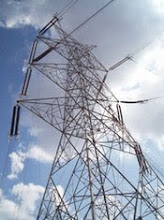
A press release hit my inbox over the weekend that sent me into a nostalgic YouTube spiral. Apparently AEP Texas, Public Service of Oklahoma and the Southwestern Electric Power Co. are bringing back their Louie the Lightning Bug character in safety literature aimed at school kids.
After watching a few of "Louie's" old PSAs, I started emailing people I know who live all over the country to see how widespread the little guy's fame was. Just about everyone remembered him once they saw a clip.
If you don't remember Louie, he was a prominent figure during your Saturday morning cartoons, where his PSAs (sponsored by your regional utilities) would warn you about the dangers of fallen power lines, flying kites near power lines, or messing around with power outlets and cords in the household. (click hyperlinks to see the YouTube videos)
The voice of Louie and his animation style could be familiar to you even if you don't recognize him on sight. In his original PSAs, Louie was voiced (and sung) by Jack Sheldon, whose voice also featured prominently in "Schoolhouse Rock!" Especially the "I'm Just a Bill" skit, that walks kids through how a bill becomes a law.
Being reminded of this stuff and seeing how much of the visuals and music that I actually remember to this very day made me wonder why companies don't bother much with public service announcements anymore. They were hugely popular in the '70s and '80s, made big contributions to pop culture and were clearly successful in communicating their messages.
Utilities are always talking about the lessons they need the public to understand. Maybe a PSA with a catchy tune is in order every now and then.
Showing posts with label safety. Show all posts
Showing posts with label safety. Show all posts
Monday, April 15, 2013

Thursday, April 4, 2013
First fatal accident at Arkansas Nuclear One is painful for many
By Teresa Hansen
Editor in Chief
You've probably heard by now that a fatality accident occurred on Easter morning at Entergy's Arkansas Nuclear One Unit 1 in Russellville, Ark. The accident was an industrial accident and did not involve the nuclear side of the plant, so the public and most workers on site were never at risk.
The worker who died and eight other injured workers were removing handrails in the travel path of a generator stator replacement project when the lift system collapsed and the stator fell. Unit 1 is offline for maintenance, which included the turbine-generator work.
Any accident at a power plant, especially a nuclear power plant, resulting in injury or loss of life is certainly tragic. For me, this accident seems almost personal. I got my start in the electric utility industry at Arkansas Nuclear One, where I worked for 13 years. I still have many ties to the area. In fact, I was in Russellville celebrating Easter with my family when I heard about the accident.
I've been reading about it daily in the local newspaper and have read statements from people with whom I once worked closely. My heart goes out to the family of the young man who died, and to the people who work at the plant. I know from first-hand experience that it is a close-knit group and those who work at and manage the plant are heartsick. Russellville itself is a close-knit community that has been hit hard by this tragedy.
Arkansas Nuclear One Unit 1 came online in 1975 and Unit 2 came online in 1980. Construction began almost a decade earlier. This is the first fatality accident at the plant and as far as I know it was the first serious accident. I hope the fact that it occurred at a nuclear power plant doesn't create negative press or taint public opinion about the nuclear power industry. Such an accident could have occurred at any industrial facility.
I will continue to follow the news of the accident as Entergy and federal authorities work to determine what went wrong. We will update this website as new information is released. In the meantime, please let this tragedy be a reminder for you to make safety your No. 1 priority.
Editor in Chief
You've probably heard by now that a fatality accident occurred on Easter morning at Entergy's Arkansas Nuclear One Unit 1 in Russellville, Ark. The accident was an industrial accident and did not involve the nuclear side of the plant, so the public and most workers on site were never at risk.
The worker who died and eight other injured workers were removing handrails in the travel path of a generator stator replacement project when the lift system collapsed and the stator fell. Unit 1 is offline for maintenance, which included the turbine-generator work.
Any accident at a power plant, especially a nuclear power plant, resulting in injury or loss of life is certainly tragic. For me, this accident seems almost personal. I got my start in the electric utility industry at Arkansas Nuclear One, where I worked for 13 years. I still have many ties to the area. In fact, I was in Russellville celebrating Easter with my family when I heard about the accident.
I've been reading about it daily in the local newspaper and have read statements from people with whom I once worked closely. My heart goes out to the family of the young man who died, and to the people who work at the plant. I know from first-hand experience that it is a close-knit group and those who work at and manage the plant are heartsick. Russellville itself is a close-knit community that has been hit hard by this tragedy.
Arkansas Nuclear One Unit 1 came online in 1975 and Unit 2 came online in 1980. Construction began almost a decade earlier. This is the first fatality accident at the plant and as far as I know it was the first serious accident. I hope the fact that it occurred at a nuclear power plant doesn't create negative press or taint public opinion about the nuclear power industry. Such an accident could have occurred at any industrial facility.
I will continue to follow the news of the accident as Entergy and federal authorities work to determine what went wrong. We will update this website as new information is released. In the meantime, please let this tragedy be a reminder for you to make safety your No. 1 priority.
Wednesday, June 29, 2011
Planning focus and public fear
After Fukushima, power plants and vertical utilities---especially nuclear ones---can’t catch a break.
Despite fervent planning and detailed execution, the Fort Calhoun nuclear plant is still caught in the “we’re not them” excuse cycle this week. They get to bail out public perception while they bail out river water.
Disaster planning has long been a staple of utility emergency procedures, but a string of storms, flooding, tornadoes and other bits of weather nastiness have the American public wondering if the industry is doing enough to prevent injuries, deaths and outages. But, can a utility really do more than plan for established scenarios? Should they be expected to anticipate every possible bad decision and each hearty gust of wind?
Returning to Nebraska and Fort Calhoun, the employees there tried diligently to ward off Japanese comparisons by opening their flooded power plant to journalists. CNN reported this week that they were allowed inside access. Plus, the CEO of Fort Calhoun pointed out, through a lengthy quote in the CNN article, that no flood water had breached the reactor, that the reactor itself was covered with borated water as it should be.
Now, the close time-proximity to Fukushima’s disaster, of course, played a large part in how quickly and how carefully Fort Calhoun had to react to public fears. But Calhoun isn’t the only utility under pressure to show their disaster planning hand to the American public today. There was also a series of small town newspaper reports this week on the Tennessee Valley Authority (TVA) and its recovery from the April storms that knocked out power in the South.
Apparently, this series of stories was sparked by one Republican representative from the state of Maryland making a remark that the blackouts from those April storms showed the power grid as vulnerable. In fact, he’s quoted repeatedly in those stories as saying the grid is “very much on edge.”
This prompted a quick response from TVA. The bottom line of all responses was this: You can’t accurately predict or prevent weather damage completely, and no power grid can be made immune to weather. Having poles in the sky makes one at the mercy of the wind. That’s pretty much a fact of our grid structure. But, the key isn’t shoring up beforehand, it’s following up quickly.
In fact, most disaster planning---like TVA’s stellar storm clean-up work---is about response rather than prevention. Perhaps that representative thought that the days some people went without power in the region was an excessive outcome of the storms. But, weather predictions will have to get much more accurate, and we’d have to spend a lot more money on undergrounding miles and miles of line, in order to even begin a prevention program. And, if fear wasn’t the background of that vulnerability statement, the expense of this request would, normally, curb a political response in these times of recession. After all, a prevention program to ward off Mother Nature that would cost the taxpayers billions goes against the anti-spending rallying cry.
Still, even with events that are unpredictable or unthinkable, the American public expects utilities to have not just prevention options but detailed contingency plans. Take the recent lawsuit against Xcel Energy over the unfortunate accidental deaths of five contract workers at their plant in 2007. A fire killed men brought in from a coating company in California to paint a penstock. The fire blocked the only escape route, and, despite attempts at dropping rescue equipment and plans to pull the workers out from above, the men perished.
Xcel said that the responsibility lied with the contractor and the men involved. (Apparently, there was a mistake made onsite with chemical mixing that ignited the fire.) But, federal prosecutors blamed Xcel and took them to court for violating safety regulations.
Xcel was found innocent this week, but a legal ruling doesn’t often change public perception. And the question of whether those men could have been saved by a better disaster plan on the part of Xcel will likely haunt the company and the families of those men---just as the disaster unraveling Fukushima will continue to plague every nuclear plant around the world with as much as a minor case of the hiccups and the idea of stronger infrastructure will follow every storm-related power outage.
Utilities will always be planning for disasters, but the American public will always expect improvements in that planning---adjustments, changes, investments, upgrades. And the two will likely never meet in a central, agreed upon spot. Utilities are thinking from both a community and a business perspective; the public is thinking from an individual protection perspective. And, unfortunately, the end result will likely never make either camp completely happy. But, we keep striving for a balance. That’s about all we can do, really, besides hoping that the weather quiet down a bit and that no one ever makes a mistake again.
But, the planning is all we have any actual control over. Human nature and Mother Nature cannot be adjusted to suit our desires, unfortunately.
Despite fervent planning and detailed execution, the Fort Calhoun nuclear plant is still caught in the “we’re not them” excuse cycle this week. They get to bail out public perception while they bail out river water.
Disaster planning has long been a staple of utility emergency procedures, but a string of storms, flooding, tornadoes and other bits of weather nastiness have the American public wondering if the industry is doing enough to prevent injuries, deaths and outages. But, can a utility really do more than plan for established scenarios? Should they be expected to anticipate every possible bad decision and each hearty gust of wind?
Returning to Nebraska and Fort Calhoun, the employees there tried diligently to ward off Japanese comparisons by opening their flooded power plant to journalists. CNN reported this week that they were allowed inside access. Plus, the CEO of Fort Calhoun pointed out, through a lengthy quote in the CNN article, that no flood water had breached the reactor, that the reactor itself was covered with borated water as it should be.
Now, the close time-proximity to Fukushima’s disaster, of course, played a large part in how quickly and how carefully Fort Calhoun had to react to public fears. But Calhoun isn’t the only utility under pressure to show their disaster planning hand to the American public today. There was also a series of small town newspaper reports this week on the Tennessee Valley Authority (TVA) and its recovery from the April storms that knocked out power in the South.
Apparently, this series of stories was sparked by one Republican representative from the state of Maryland making a remark that the blackouts from those April storms showed the power grid as vulnerable. In fact, he’s quoted repeatedly in those stories as saying the grid is “very much on edge.”
This prompted a quick response from TVA. The bottom line of all responses was this: You can’t accurately predict or prevent weather damage completely, and no power grid can be made immune to weather. Having poles in the sky makes one at the mercy of the wind. That’s pretty much a fact of our grid structure. But, the key isn’t shoring up beforehand, it’s following up quickly.
In fact, most disaster planning---like TVA’s stellar storm clean-up work---is about response rather than prevention. Perhaps that representative thought that the days some people went without power in the region was an excessive outcome of the storms. But, weather predictions will have to get much more accurate, and we’d have to spend a lot more money on undergrounding miles and miles of line, in order to even begin a prevention program. And, if fear wasn’t the background of that vulnerability statement, the expense of this request would, normally, curb a political response in these times of recession. After all, a prevention program to ward off Mother Nature that would cost the taxpayers billions goes against the anti-spending rallying cry.
Still, even with events that are unpredictable or unthinkable, the American public expects utilities to have not just prevention options but detailed contingency plans. Take the recent lawsuit against Xcel Energy over the unfortunate accidental deaths of five contract workers at their plant in 2007. A fire killed men brought in from a coating company in California to paint a penstock. The fire blocked the only escape route, and, despite attempts at dropping rescue equipment and plans to pull the workers out from above, the men perished.
Xcel said that the responsibility lied with the contractor and the men involved. (Apparently, there was a mistake made onsite with chemical mixing that ignited the fire.) But, federal prosecutors blamed Xcel and took them to court for violating safety regulations.
Xcel was found innocent this week, but a legal ruling doesn’t often change public perception. And the question of whether those men could have been saved by a better disaster plan on the part of Xcel will likely haunt the company and the families of those men---just as the disaster unraveling Fukushima will continue to plague every nuclear plant around the world with as much as a minor case of the hiccups and the idea of stronger infrastructure will follow every storm-related power outage.
Utilities will always be planning for disasters, but the American public will always expect improvements in that planning---adjustments, changes, investments, upgrades. And the two will likely never meet in a central, agreed upon spot. Utilities are thinking from both a community and a business perspective; the public is thinking from an individual protection perspective. And, unfortunately, the end result will likely never make either camp completely happy. But, we keep striving for a balance. That’s about all we can do, really, besides hoping that the weather quiet down a bit and that no one ever makes a mistake again.
But, the planning is all we have any actual control over. Human nature and Mother Nature cannot be adjusted to suit our desires, unfortunately.
Subscribe to:
Posts (Atom)