IBM’s Watson robot triumphed on Jeopardy recently. While the geek guru of trivia stumbled a bit on the first day and had a tendency to answer really, really wrong when it was wrong and bet in odd, seemingly random cash sums, the computer came roaring back to leave the champion human contestants in the dust.
Did any of us really question that the computer would beat the humans at trivia?
Computers are like little digital elephants. They don’t forget. I once memorized all the U.S. presidents, their terms in office, their vice presidents, their major accomplishments and their major failures for a college class on American history. But, I’d be hard-pressed to remember much of that list today. The human brain doesn’t retain knowledge it doesn’t use often---at least, not very well and not completely or I wouldn’t have such trouble with maps of Africa.
If a computer “brain” had the gaps in it that my brain has (especially for presidents between Lincoln and Roosevelt #1), I’d be sorely disappointed in that computer. I’d think it a colossal failure if its digital circuits sparked and burnt out the way my organic ones often do.
But, Watson triumphed, and at least IBM cheered. Personally, I’m not sure what to make of Watson, exactly. I hear that the next stop on Watson’s smarter planet world tour, of sorts, is to help with medical diagnosis. Watson can take in and hold a lot of factors, facts, stats and charts that a human doctor cannot. I can see how that might be useful. But, Watson is lacking one thing you can’t ever teach a computer---human reasoning.
Yes, you can program Watson with all sorts of data. You can tell him that A + B + Ru + the speed of light over the square root of pie + a fever equals Z. And, when he sees A + B + Ru + the speed of light over the square root of pie and, by golly, a fever, he’ll cry, in rather digital tones, “Eureka, Z it is.” But, what if it only looks like Z? What if Z is the wrong answer and you have to work backward to find the right one? In Watson’s world, the answer must always be Z given those factors. Humans are a little better at realizing that factors and data aren’t the whole picture.
Still, Watson can be a great help. In our industry, IBM has pitched that Watson can assist with energy efficiency in the field and in educating consumers about use. (And, oh yes, kids and geeks alike will love learning via Watson. He’s like the world’s most advanced See ‘n’ Say.)
IBM also posits that Watson can help make decisions in utility control rooms, mostly due to his ability to understand “natural language” questions. This means you can ask Watson questions in English, and he can translate it, basically, into the digital format he works in. But, bear in mind that, essentially, Watson isn’t a native speaker of English. We natives talk weird. We drop syllables. We don’t form complete sentences. We each have our own way of speaking and writing; we complicate language with individual styles. Plus, words have subtext related to vocal inflection and context. In talking, we often get the gist of things, not every word. We grasp the overall concepts with language. We work in big pictures, and Watson sees in singular, linear details.
Singular, linear details are great for a computer, but not so great in a world built by humans for humans with human-caused and human-impacted problems which careen off the logical line in nifty and tangential ways.
Still, I will be very interested to watch Watson evolve in the field as he works with doctors and energy personnel. I’m sure he will continue to add to his extensive bit of knowledge---those details of facts and data and trivia. But, I really want to watch Watson move past the elementary item of natural language interface to something more analytical and more profound. If IBM can truly accomplish that, then as Ken Jennings noted during final Jeopardy with Watson, “I, for one, welcome our computer overlords.”
OK. Well, maybe I’ve seen the Terminator series too many times to go quite as far as Ken. But, I would welcome all the intelligent help we can get in power control rooms.
Bring on the rise of the power robots, IBM.
Thursday, February 24, 2011

Wednesday, February 16, 2011
Study to electric utilities: Tell businesses the truth
J.D. Power and Associates released a report today on business customers’ reactions to power outages and outage management. While a bit happier and less emotional, overall, than their residential counterparts, there still seems to be a lesson in all these numbers: Dear utility, don’t shorten the outage time.
The J.D. Power and Associates 2011 Electric Utility Business Customer Satisfaction Study is based on interviews with people from 17,000 U.S. businesses that spend $500-$50,000 a month on those power bills. Those study Associates measured customer satisfaction looking at: power quality and reliability; billing and payment; corporate citizenship; price; communications; and, of course, customer service.
If the surveyed business had an outage, the average satisfaction rating was 729 out of 1,000 points---about a middling “C” grade for those of us still judging things based on old school report cards. And that “C” was only if the power clicked back on by the time told them. If the utility stretched the outage (for whatever reason, even those beyond their control) past the hour given by the utility, that grade plummeted to 576. (That’s a whopping 150-point plunge, and an “F” on the school report card scale.)
So, the lesson here: Be accurate. Tell the truth. Don’t give the best-guess estimate. The customer wants to know when it’s really going to be back up and making them money again. If it’s going to be a long time, be honest. And, let them know why.
The survey noted: Among business customers who contact their utility for information about an outage, satisfaction levels are highest among those who received at least three points of information. Satisfaction is lowest among customers who only received one piece of information.
“While causes of power outages may be outside the control of electric providers, they do have the ability to establish highly satisfying procedures for making adequate outage information available to customers,” said Jeff Conklin, senior director of the energy utility practice at J.D. Power and Associates. “Particularly for business customers, time is money. Providing accurate and comprehensive information about outages can help these customers make contingency plans and effectively plan resumption of their operations.”
The second lesson here: The customers expect you to know. True, you may not have the shiny smart grid intelligence to even get a bead on where the outage is without sending out some guys in a truck to just drive around the darkened spots. But, customers don’t know that. They hear a lot about the smart grid; they think you have one. They think there’s a robot or magic computer connection on that line. They believe that the very moment power goes out, you know. And they also believe you should know how long it takes to get that power back on. Whether or not you think that’s fair, that’s the business world you’re working in these days.
The study also noted a decline in overall satisfaction among business people with their power companies---not much, about four points, but that decline happened across a number of areas with the biggest dips in power quality and reliability (7 points) and customer service (5 points). Do you really have worse power than you did last year? Of course not. Do you have worse customer service? Perhaps. Either way, what’s important here is, again, what customers believe. They believe you know more than you are saying about outages. They believe your power is not as awesome as it was before, and they think your customer service isn’t so hot.
You can fix those beliefs with some extra time and extra communication, but the key is to be truthful and accurate---even letting them know when you don’t know. Sometimes honesty really is the best policy.
The J.D. Power and Associates 2011 Electric Utility Business Customer Satisfaction Study is based on interviews with people from 17,000 U.S. businesses that spend $500-$50,000 a month on those power bills. Those study Associates measured customer satisfaction looking at: power quality and reliability; billing and payment; corporate citizenship; price; communications; and, of course, customer service.
If the surveyed business had an outage, the average satisfaction rating was 729 out of 1,000 points---about a middling “C” grade for those of us still judging things based on old school report cards. And that “C” was only if the power clicked back on by the time told them. If the utility stretched the outage (for whatever reason, even those beyond their control) past the hour given by the utility, that grade plummeted to 576. (That’s a whopping 150-point plunge, and an “F” on the school report card scale.)
So, the lesson here: Be accurate. Tell the truth. Don’t give the best-guess estimate. The customer wants to know when it’s really going to be back up and making them money again. If it’s going to be a long time, be honest. And, let them know why.
The survey noted: Among business customers who contact their utility for information about an outage, satisfaction levels are highest among those who received at least three points of information. Satisfaction is lowest among customers who only received one piece of information.
“While causes of power outages may be outside the control of electric providers, they do have the ability to establish highly satisfying procedures for making adequate outage information available to customers,” said Jeff Conklin, senior director of the energy utility practice at J.D. Power and Associates. “Particularly for business customers, time is money. Providing accurate and comprehensive information about outages can help these customers make contingency plans and effectively plan resumption of their operations.”
The second lesson here: The customers expect you to know. True, you may not have the shiny smart grid intelligence to even get a bead on where the outage is without sending out some guys in a truck to just drive around the darkened spots. But, customers don’t know that. They hear a lot about the smart grid; they think you have one. They think there’s a robot or magic computer connection on that line. They believe that the very moment power goes out, you know. And they also believe you should know how long it takes to get that power back on. Whether or not you think that’s fair, that’s the business world you’re working in these days.
The study also noted a decline in overall satisfaction among business people with their power companies---not much, about four points, but that decline happened across a number of areas with the biggest dips in power quality and reliability (7 points) and customer service (5 points). Do you really have worse power than you did last year? Of course not. Do you have worse customer service? Perhaps. Either way, what’s important here is, again, what customers believe. They believe you know more than you are saying about outages. They believe your power is not as awesome as it was before, and they think your customer service isn’t so hot.
You can fix those beliefs with some extra time and extra communication, but the key is to be truthful and accurate---even letting them know when you don’t know. Sometimes honesty really is the best policy.
Wednesday, February 2, 2011
LIVE FROM DISTRIBUTECH 2: Let's talk EVs
In electric vehicle news today, researchers at Indiana University think Obama's "one million electric cars by 2015" dream will be shattered by car manufacturers who won't rev up supply because they don't think the American consumer will answer with matching demand.
The timing of this study's release is most interesting to me because I spent a good block of time today at DistribuTECH talking to ABB and ECOtality about their electric vehicle (EV) plans.
ECOtality provides EV charging systems. Last month, at the turn of 2011, ABB announced a $10 million investment in ECOtality. ECOtality, in turn, is leading the EV Project, a DOE-funded program to develop electric vehicle infrastructure with the deployment of 15,000 charging stations in 16 cities.
Murray Jones, vice president of global e-mobility at ABB, called this "range ready infrastructure" in our meeting today, which I found most intriguing---that someone is building out a basic highway charging infrastructure for EVs for a good road trip. Fleets of EVs are one thing. Distribution systems are circular, without a lot of miles traveled, and with a return trip to a central charging area. That may be how some businesses work, but that's not how the average American lives. Putting charging infrastructure along the road---at restaurants and retail outlets---and really developing an infrastructure to ease the mind of the consumer certainly seems like a step forward to getting the second wave of EV adoption, beyond the early birds that love that electric car for its ecology marketing or as a second car that cuts down on gas costs.
"We're building up a connected highway," said Jonathan Read, president and CEO of ECOtality, when discussing the EV Project that ranges across the West from Seattle to San Diego and has extensions into Arizona, Texas, and three cities in Tennessee. The ultimate goal of the EV Project is to take the lessons learned from the deployment of these first 8,300 EVs and related infrastructure to make it easier and faster to put in more---to Obama's one million and beyond.
To put those EVs on the road takes more than car companies or even consumer demand. It will take a ready, willing and enabled power utility. That's where ABB comes into the game.
Read added, "In each market, we have to work with utilities, and no one know utilities better than ABB."
ABB and ECOtality believe that those EVs on Obama's horizon are coming, and they want to work to make EVs a real asset to the grid rather than a "drag on it," as Read noted. Allen Burchett, senior vice president for strategic initiatives in North America for ABB added that it's obvious that EVs will have a major impact on the electricity distribution network, but, if utilities have more control over the timing of personal charging, it can be a positive impact, relaying on the intelligence of the charging infrastructure.
As for the Obama dream of a million EVs, Read believes that there may be as many as 1.5 million by 2015, exceeding Obama's vision. Perhaps those naysayers at Indiana University are wrong after all.
LIVE FROM DISTRIBUTECH: It's about the customer
DistribuTECH 2011 kicked off in San Diego yesterday (with a few pre-conference sessions and meetings beforehand) and from the co-located SGCC symposium to the keynote to my personal meetings, almost everyone is talking about the customer---and not just internal industry customers, truly about the end-use consumer (an idea rather foreign to traditional utilities who always had a bit of a monopoly and could simply assume demand without catering to consumers).
During the Smart Grid Consumer Collaborative's (SGCC) Smart Grid Symposium (also titled the "Partnering for Progress" Symposium) on Monday, debate about how much, how often, how nicely utilities need to communicate with consumers was the stuff of panel debates and paper releases.
SGCC released their 2011 State of the Consumer report to "shed light on what residential electric consumers want." What do they want? To know more, apparently---especially about the smart grid---if they have the values and priorities that fit into the smart grid overview. (The report noted that personal mores and hierarchies trumped age or income factors.)
When discussing this report and the motivated smart grid energy consumer at the meeting, SGCC Research Director Judith Schwartz noted, : The big picture may change, but the major players for change had to have passion, had to care."
Schwartz made the comment during a debate on customer wants and needs, acceptances and doubts.
But she found a bit of disagreement with Ahmad Faruqui, principal with the Brattle Group, who made the point that asking people what they would do in a situation and what those people actually end up doing in a situation when finally faced with it, are often very different prospects, which may be a flaw in reasoning out the psychology of consumer smart grid choices.
All the panelists, however, seemed to agree that bringing the consumer into the smart grid conversation was absolutely necessary since, really, the mainstream views of smart grid are often negative.
As panelist Craig Boice, president of the Boice Dunham Group pointed out, the most successful smart grid marketing, to date, was created by the opponents of smart grid in the San Francisco area who changed the community view of smart grid to a negative one in six to nine months time.
"The smart grid story we are telling, "Boice noted, "well, we just haven't found a way to get the customer into that story."
These customer-centric words were echoed in the opening keynote session of DistribuTECH the next morning by representatives from local California utilities and industry commentators and analysts.
David Geier, vice president of electric operations at San Diego Gas and Electric stated, "We can have all the great ideas in the world, but they need to align with and benefit our customers."
Lynda Ziegler, senior vice president of customer service at Southern California Edison agreed with Geier, noting that we, as an industry, have not yet incorporated educated consumers into the equation nor looked at areas consumers are really concerned with: cost, safety, accuracy, security and health issues like EMF.
"If consumers see no benefits to the smart grid, it will be difficult to move forward," she said. "We all have a role to play in the public conversation."
The industry conversation about smart grid continues this week at DistribuTECH. We'll be here in sunny San Diego until the end of the week---most likely talking more about the consumer. We'll keep you updated.
Additionally, our online editor, Jeff Postelwait, is onsite giving you the latest news from the conference. He's streaming that to the news section of the home page. So, take a look at the home page for a peek at the products, announcements, partnerships and collaborative projects from DistribuTECH 2011 this week.
Monday, January 24, 2011
Old cowboys rescue New World
Ted Turner’s at it again. No, he didn’t buy another set of cable stations or a new bevy of bison; he’s out to solar the Wild West.
Turner and Southern Company announced today that their Cimarron Solar Facility in New Mexico is up and zipping out enough voltage to power 9,000 homes. The Turner Renewable Energy, Southern Company cooperative effort picked up the project from First Solar last March.
"We are very excited to see this project completed and producing clean solar energy to power homes and businesses in New Mexico," Turner was quoted as quipping about the project. "Large-scale solar generation is among the fastest growing energy sources in the world, and we're pleased that we can be a part of that growth."
Turner is known for doing his own thing at his own pace; so, his leap from TV to rancher to solar scholar isn’t all that out of his normal range. However, what’s surprising is the number of old school cowboys (both real and imaginary) that have joined him on the renewable energy side of things.
Let’s be honest. Cowboys don’t really have an image of progressiveness. Old trucks, old dogs and old horses are more their style. But, renewables---especially solar---may be a dark horse in this cowboy race.
Let’s take the ultimate TV cowboy from the 1980s, good ol’ boy J.R. Ewing, who stopped time (it seemed) until their writers of “Dallas” finally revealed who shot him. The actor who played J.R., Larry Hagman, popped up last summer hocking SolarWorld, a German photovoltaic module maker. The commercials played off the cowboy/oil days of old and offered a new and shiny energy alternative in solar.
And Hagman himself does have a 94-kilowatt solar system on his estate in Southern California. He also sits on the board of a nonprofit group that helps build solar systems in places of hardship and poverty worldwide.
Hagman isn’t the only oil-based cowboy (albeit an imaginary one) to embrace renewables. In real life, Oklahoma oilman (and self-proclaimed Oklahoma State University cowboy) T. Boone Pickens has introduced “The Pickens Plan” which is a long-term energy plan to get off of oil by using a whole lot of wind and natural gas transportation. Of course, this was a great idea for him since he was all set to invest a ton in a Texas wind farm that, unfortunately, never got off the ground, leaving him with a lot of wind turbines to spread around.
But, the interesting connection between these three cowboys remains that investment in renewables. As Pickens saw a huge market in consolidating oil companies in the 1980s, it appears he may see another ground floor opening with renewables this time around.
And a couple of other cowboys seem to see that on the horizon as well. Wind farms and solar arrays do speak to the loner spirit of the cowboy---being far away but still managing a few creature comforts. And, perhaps it also speaks to the push cowboys often have to forage into new territory and new frames of mind. It may be that old cowboys will ride to the rescue of this new world (at least in the form of renewable energy) after all, leaving me to wonder: Are renewables the next “oil boom,” so to speak?
Turner and Southern Company announced today that their Cimarron Solar Facility in New Mexico is up and zipping out enough voltage to power 9,000 homes. The Turner Renewable Energy, Southern Company cooperative effort picked up the project from First Solar last March.
"We are very excited to see this project completed and producing clean solar energy to power homes and businesses in New Mexico," Turner was quoted as quipping about the project. "Large-scale solar generation is among the fastest growing energy sources in the world, and we're pleased that we can be a part of that growth."
Turner is known for doing his own thing at his own pace; so, his leap from TV to rancher to solar scholar isn’t all that out of his normal range. However, what’s surprising is the number of old school cowboys (both real and imaginary) that have joined him on the renewable energy side of things.
Let’s be honest. Cowboys don’t really have an image of progressiveness. Old trucks, old dogs and old horses are more their style. But, renewables---especially solar---may be a dark horse in this cowboy race.
Let’s take the ultimate TV cowboy from the 1980s, good ol’ boy J.R. Ewing, who stopped time (it seemed) until their writers of “Dallas” finally revealed who shot him. The actor who played J.R., Larry Hagman, popped up last summer hocking SolarWorld, a German photovoltaic module maker. The commercials played off the cowboy/oil days of old and offered a new and shiny energy alternative in solar.
And Hagman himself does have a 94-kilowatt solar system on his estate in Southern California. He also sits on the board of a nonprofit group that helps build solar systems in places of hardship and poverty worldwide.
Hagman isn’t the only oil-based cowboy (albeit an imaginary one) to embrace renewables. In real life, Oklahoma oilman (and self-proclaimed Oklahoma State University cowboy) T. Boone Pickens has introduced “The Pickens Plan” which is a long-term energy plan to get off of oil by using a whole lot of wind and natural gas transportation. Of course, this was a great idea for him since he was all set to invest a ton in a Texas wind farm that, unfortunately, never got off the ground, leaving him with a lot of wind turbines to spread around.
But, the interesting connection between these three cowboys remains that investment in renewables. As Pickens saw a huge market in consolidating oil companies in the 1980s, it appears he may see another ground floor opening with renewables this time around.
And a couple of other cowboys seem to see that on the horizon as well. Wind farms and solar arrays do speak to the loner spirit of the cowboy---being far away but still managing a few creature comforts. And, perhaps it also speaks to the push cowboys often have to forage into new territory and new frames of mind. It may be that old cowboys will ride to the rescue of this new world (at least in the form of renewable energy) after all, leaving me to wonder: Are renewables the next “oil boom,” so to speak?
Thursday, January 13, 2011
On outages and clear Oklahoma skies
Another blizzard has hit the Northeast. Atlanta is frozen solid. There’s snow in 49 of the 50 states, according to CNN, even here in Tulsa. But, today, we have a clear, bright blue Oklahoma sky reflected in that remaining white.
There’s a lot of real estate in the sky in Oklahoma. The blue horizon seems to go up and out forever, an endless ceiling with no glass barrier in sight. On days like today, it’s almost impossible to believe that the bright blue ends somewhere, that eventually the dark of space will interfere and stop that tinted ascent.
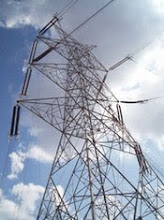
We don’t put a lot of skyscrapers into the real estate of an Oklahoma sky, but we do put quite a bit of one thing---electricity. Towers and poles dominate the landscape here. They trace along highways and roads, turn left or right to follow the bits of civilization and urban sprawl. They go up and out the way Manhattan builds office buildings.
It makes for cheaper energy. It makes for quicker hook-ups if you decide to build out in the middle of an Oklahoma nowhere to enjoy that deep blue overhead real estate.
But, sometimes, it can be problematic.
Sometimes the real estate above our heads in Oklahoma isn’t that bright blue we’re used to. Sometimes it’s black or gray or even green. Green’s the worst. That means tornado. But black can also bring strong winds, sometimes hurricane force. And gray can mean a whole lot of ice---all items that can destroy the biggest builds of our Oklahoma sky, that power structure.
When the worst ice storm in state history hit here in 2007, the parts of Tulsa with lots of power real estate in the sky were crippled. Poles were down everywhere. Transformers exploded. It was chaos---except in those newer spots with underground equipment. They had a few spotty power outages but, all in all, maintained a good front.
After that storm, I thought, “Perhaps we should stop building our power structures into the bright blue of the Oklahoma sky.”
However, there is a problem with moving all these bits and pieces underground: cost. It’s expensive. And, locally, for a utility caught in a recession and already hurting from a series of bad winters (including that historic ice storm), it’s not something easily done.
I know our utility is anxious to return to upkeep and undergrounding, but I also realize their dilemma with cost and cutbacks. And, while the average customer might love the reliability and safety from ice and wind that underground power provides, they are not willing to pay out of pocket for it. Again, this is as equally understandable as the utility’s bottom line concerns. So, no fair pointing fingers at each other with this argument.
For the moment, the real estate in that Oklahoma sky remains the most practical power option. I’ll just keep an eye out for the blue to change to black or gray and hope that our infrastructure in the air can be spared---at least until the utility can spring for undergrounding things again (or customers are willing to pay for it). Until then, power will remain in the air, and there’s just not much we can do about it from our spot on terra firma below.
There’s a lot of real estate in the sky in Oklahoma. The blue horizon seems to go up and out forever, an endless ceiling with no glass barrier in sight. On days like today, it’s almost impossible to believe that the bright blue ends somewhere, that eventually the dark of space will interfere and stop that tinted ascent.
We don’t put a lot of skyscrapers into the real estate of an Oklahoma sky, but we do put quite a bit of one thing---electricity. Towers and poles dominate the landscape here. They trace along highways and roads, turn left or right to follow the bits of civilization and urban sprawl. They go up and out the way Manhattan builds office buildings.
It makes for cheaper energy. It makes for quicker hook-ups if you decide to build out in the middle of an Oklahoma nowhere to enjoy that deep blue overhead real estate.
But, sometimes, it can be problematic.
Sometimes the real estate above our heads in Oklahoma isn’t that bright blue we’re used to. Sometimes it’s black or gray or even green. Green’s the worst. That means tornado. But black can also bring strong winds, sometimes hurricane force. And gray can mean a whole lot of ice---all items that can destroy the biggest builds of our Oklahoma sky, that power structure.
When the worst ice storm in state history hit here in 2007, the parts of Tulsa with lots of power real estate in the sky were crippled. Poles were down everywhere. Transformers exploded. It was chaos---except in those newer spots with underground equipment. They had a few spotty power outages but, all in all, maintained a good front.
After that storm, I thought, “Perhaps we should stop building our power structures into the bright blue of the Oklahoma sky.”
However, there is a problem with moving all these bits and pieces underground: cost. It’s expensive. And, locally, for a utility caught in a recession and already hurting from a series of bad winters (including that historic ice storm), it’s not something easily done.
I know our utility is anxious to return to upkeep and undergrounding, but I also realize their dilemma with cost and cutbacks. And, while the average customer might love the reliability and safety from ice and wind that underground power provides, they are not willing to pay out of pocket for it. Again, this is as equally understandable as the utility’s bottom line concerns. So, no fair pointing fingers at each other with this argument.
For the moment, the real estate in that Oklahoma sky remains the most practical power option. I’ll just keep an eye out for the blue to change to black or gray and hope that our infrastructure in the air can be spared---at least until the utility can spring for undergrounding things again (or customers are willing to pay for it). Until then, power will remain in the air, and there’s just not much we can do about it from our spot on terra firma below.
Monday, January 3, 2011
The Governator exits stage left
He angered his own party quite a bit. He was a definite handful---a big, brash personality difficult to compete with. He was a source of both pride and frustration for Californians---sometimes at the very same time. And, today, he is the Governator no more.
This Monday, January 3, 2011 marks Arnold Schwarzenegger's “hasta la vista” goodbye to politics in the Golden State. He is no longer a governor. He’ll just have to return to his lowly previous career as matinee god.
Thems the breaks.
Schwarzenegger blew into office a little less than 8 years ago when pretty much the entire state hated then Gov. Gray Davis and headlines like “Pacific Gas and Electric to Gov. Davis: We’re Busted” were regular bits of ink in the trade presses. Deregulation had taken the state---and the state utilities---to the cleaners, and Davis was left holding the bag, whether or not he was actually at fault.
Schwarzenegger swept in like the action hero he often portrays---trying to save the day for the state and for the state of energy.
At the time of Arnie’s big rescue, I worked for Electric Light and Power magazine and wrote a piece on Schwarzenegger’s energy plans. You can read that one HERE if you’d like to take a trip in the Way Back Machine. At that time, the only thing we were arguing about concerning Schwarzenegger was whether to use "governator" or "gubernator" as his nickname. (Governator won out, though I still prefer gubernator.)
Long story short: Arnie was going to fix it all.
"I will restore stability to our energy system and stimulate private investment in electricity generation and transmission," the governor's campaign website stated at the time. And he had a multi-point plan for doing so that included:
- reforming the 13 state agencies with sway over the markets.
- creating a regulatory structure based on "other states and the FERC standard market design" while eliminating incentives for "gaming" the regulatory system.
- investing in natural gas and transmission capacity.
- encouraging conservation.
- creating reserve requirements for generators.
- addressing "overpriced legacy power purchase agreements."
How much of that he actually did or was really necessary depends on whom you ask. No one really talks about power purchase agreements anymore, the regulatory structure in the state hasn’t truly changed all that much, but there has been movement in both transmission capacity and conservation. And he combated global warming like no Republican in history, in or out of the Golden State. In fact, last month, he was named 2010 Green Governor of the Year by the Beautiful Earth Group and Opportunity Green.
When accepting the award, Governor Schwarzenegger said, "California is showing the world that you can protect the environment and grow the economy at the same time. We are creating a new economic foundation for the 21st Century built on clean fuel, clean energy and clean cars that is turning California into the green capital of the nation and the world, and I couldn't be more proud of these accomplishments.”
Despite the California greening, the BBC reported today that Shcwarzenegger’s “political star has faded” since he came into the scene with approvals hovering in the 20 percentile range (rather close to Davis’ when he was in such hot water in 2003). But, whether you think the Schawarzenegger was a driving force for energy change or was stagnated by other issues no longer matters, really, except in terms of his legacy. Today, he hands over the state driver’s seat to Democrat Jerry Brown, a former governor who first served from 1975 to 1983.
While it is likely that Brown will continue down Arnie’s greening power path (the environment and clean energy jobs were a part of his eight-point campaign platform), one thing’s for certain, though: The official reign of the Governator is over.
No word on whether Brown will have as fabulous a nickname as Arnie. Granted, in Brown's first round as governor, he was called "Governor Moonbeam" by one journalist for his liberal policies. Somehow, that just doesn't compare. In the nickname arena, the Governator may always remain supreme.
Subscribe to:
Posts (Atom)